Research
SELF-KNOWLEDGE · · 3 min read
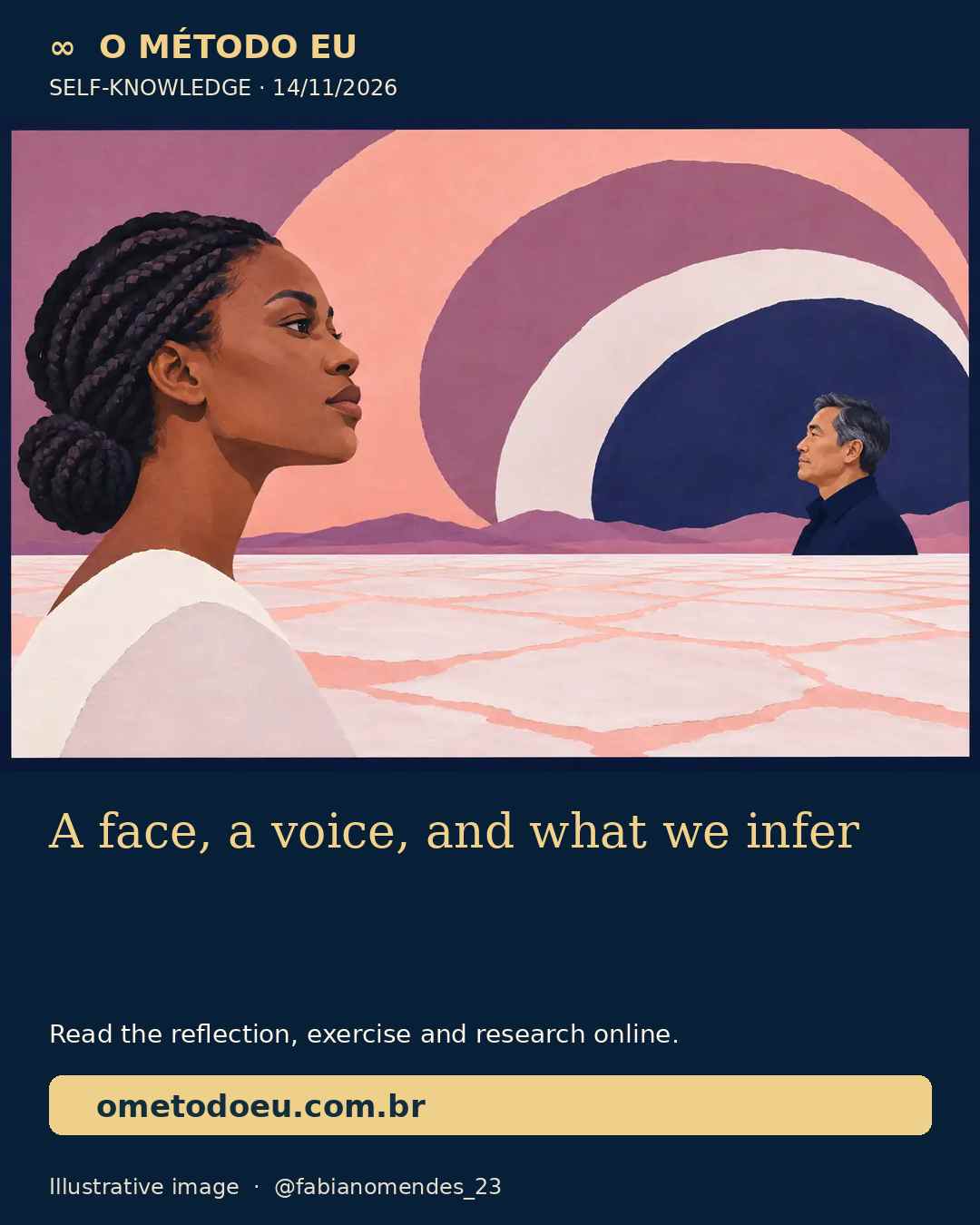
A face, a voice, and what we infer

On a phone call, you hear the pause but miss the smile. Across a crowded room, you catch a look but miss the words. Either detail can shape the story you start telling yourself about what someone meant.
When it matters, try to describe the cue before naming the feeling. A quick reply could come from hurry, irritation, or a dropped connection. If you have the chance, a plain question leaves room for the other person to tell you what you missed.
An exercise in noticing
Recall a low-stakes conversation that left you guessing. Write down one cue you actually noticed and two distinct ways to read it. If the subject comes up again and it feels appropriate, ask a question that leaves the answer open: ‘How did that land with you?’ Give yourself permission to leave some uncertainty unresolved.
Question: What did you pick up in that exchange, and what did you fill in?
An educational editorial exercise, not a clinical protocol.What the research investigated
Stefania Mattioni and colleagues affiliated with Ghent University and UCLouvain in Belgium and the University of Coimbra in Portugal studied 24 participants using functional MRI. They compared patterns of brain activity when emotional expressions were seen, heard, or presented through both senses. In many regions that responded selectively to faces or voices, patterns also carried information from the other sense. In some areas in the temporal and frontal lobes, a statistical classifier could distinguish the expression categories across sight and sound. Seeing and hearing the cues together also produced patterns that differed from those for the stronger single sense in most regions studied.
Limitations: The study used a small sample, selected expressions and a controlled imaging task. A classifier distinguishing expressions in these data cannot tell us what another person privately feels in an ordinary conversation. The study did not test whether asking for clarification improves relationships or assess the exercise in this article.
Mattioni S, Falagiarda F, Arya T, Gau R, Rezk M, Battal C, Van Audenhaege A, Collignon O. Representation of emotional expressions across the face and voice brain networks. The Journal of Neuroscience, e0366262026. DOI: 10.1523/JNEUROSCI.0366-26.2026.
Source checked on 14 November 2026. Earlier research revisited today; no claim of scientific novelty or evidence for the books.
Read the primary source →Original research date: 2026-10-19.
Entirely fictional example
Entirely fictional example: Leila heard a clipped ‘fine’ from her friend while they walked along a windy shoreline. She wondered whether he wanted to leave. When they reached a sheltered spot, she asked whether he wanted to keep walking. He was happy to stay and told her he had barely heard the question over the wind.
An invented example for reflection, not a research report, testimonial or evidence.Keywords: self-awareness, facial expressions, tone of voice, communication, neuroscience
Download the Instagram image → · Copy or download the caption →
Editorial connection with O MÉTODO EU
An editorial link to O MÉTODO EU is the chance to notice your own habit of filling in a gap, then decide whether to check your reading with the other person. The study examined responses to expressions; it did not evaluate the book.
A thematic connection made by the editorial team. These sources do not test the book’s effectiveness; the people mentioned are not presented as readers or endorsers of the book.Outros livros, edições e lojas
- Read the free sample and view editions
- View this Portuguese edition on Amazon Brazil
- Read the free sample and view editions
- View this Portuguese edition on Amazon Brazil
- Consulte os benefícios Prime na AmazonCapa comum — ideal para a prática do métodoVer na Amazon Brasil ↗*Consulte a elegibilidade Prime e as condições de entrega na Amazon. Publicidade · link de associado.
- United States · English — The Me Method ↗
- France · Français ↗
- 🌐 Choose from 13 Amazon stores →
Share: WhatsApp, Instagram, image and link
Instagram: download the image and choose it from your gallery in Instagram. Copy the caption below; use the link sticker in Stories.