SELF-KNOWLEDGE · · 3 min read
A shared rhythm, your own voice

Sometimes a group begins to feel easier when people find a shared rhythm: preparing a table, making music or taking turns at a simple task. You may notice where you fit, when you want to lead and when you prefer to watch. Those small responses can tell you something about how you experience belonging.
Why this matters now
The United Nations' 2026 calendar lists United Nations Day on 24 October, two days after this edition. The occasion provides an editorial prompt about cooperation and participation. Small-group experiments cannot explain international cooperation, and the calendar is not evidence that shared rhythm resolves conflict. The connection is a question about everyday belonging, not an equivalence between these settings.
Read the context source →Feeling connected does not require agreement with everything a group does. A welcoming activity leaves room to pause, adapt or decline. Keep your own judgment alongside the pleasure of participating. Being part of something can include asking whether others have the same freedom you have.
An exercise in noticing
If you wish, join a brief, familiar group activity that everyone has freely agreed to, such as a simple rhythm or arranging a shared table. Notice your comfort, your wish to match others and whether you can comfortably stop. Afterwards, name one thing that supported participation and one boundary you want respected. Do not pressure anyone to synchronize or treat coordinated movement as evidence of trustworthiness.
Question: When you join a group activity, what helps you participate without losing your own judgment?
An educational editorial exercise, not a clinical protocol.What the research investigated
Wiltermuth and Heath, at Stanford University in the United States, reported three experiments comparing synchronous activities with comparison conditions before economic coordination or cooperation tasks. Activities included walking in step and singing. Some later cooperative choices were greater after synchrony. In the first experiment, involving 30 participants, the difference appeared in the first round, not subsequent rounds.
Limitations: Small samples, brief activities and economic games do not establish lasting trust, moral conduct or cooperation across groups. The first study's later rounds qualify any broad claim of improvement. Drumming and table-setting here are editorial examples, not tested interventions. No benefit is promised for children, clinical conditions or these books, and participation should remain voluntary.
Wiltermuth, S. S.; Heath, C. Synchrony and Cooperation. Psychological Science, 20(1), 1–5, January 2009. DOI: 10.1111/j.1467-9280.2008.02253.x. Original article checked in the UC San Diego-hosted copy and publication record.
Source checked on 22 October 2026. Earlier research revisited today; no claim of scientific novelty or evidence for the books.
Read the primary source →Entirely fictional example
Entirely fictional example: Daniel joins neighbours for a short music session. He enjoys following a simple beat, then asks to sit out the next song. The group accepts his choice. The scene is invented to raise questions about comfort and belonging; it does not represent study participants or demonstrate an effect on cooperation.
An invented example for reflection, not a research report, testimonial or evidence.Keywords: self-knowledge, belonging, cooperation, rhythm, boundaries
Download the Instagram image → · Copy or download the caption →
Educational content for adults. It does not replace professional assessment or support.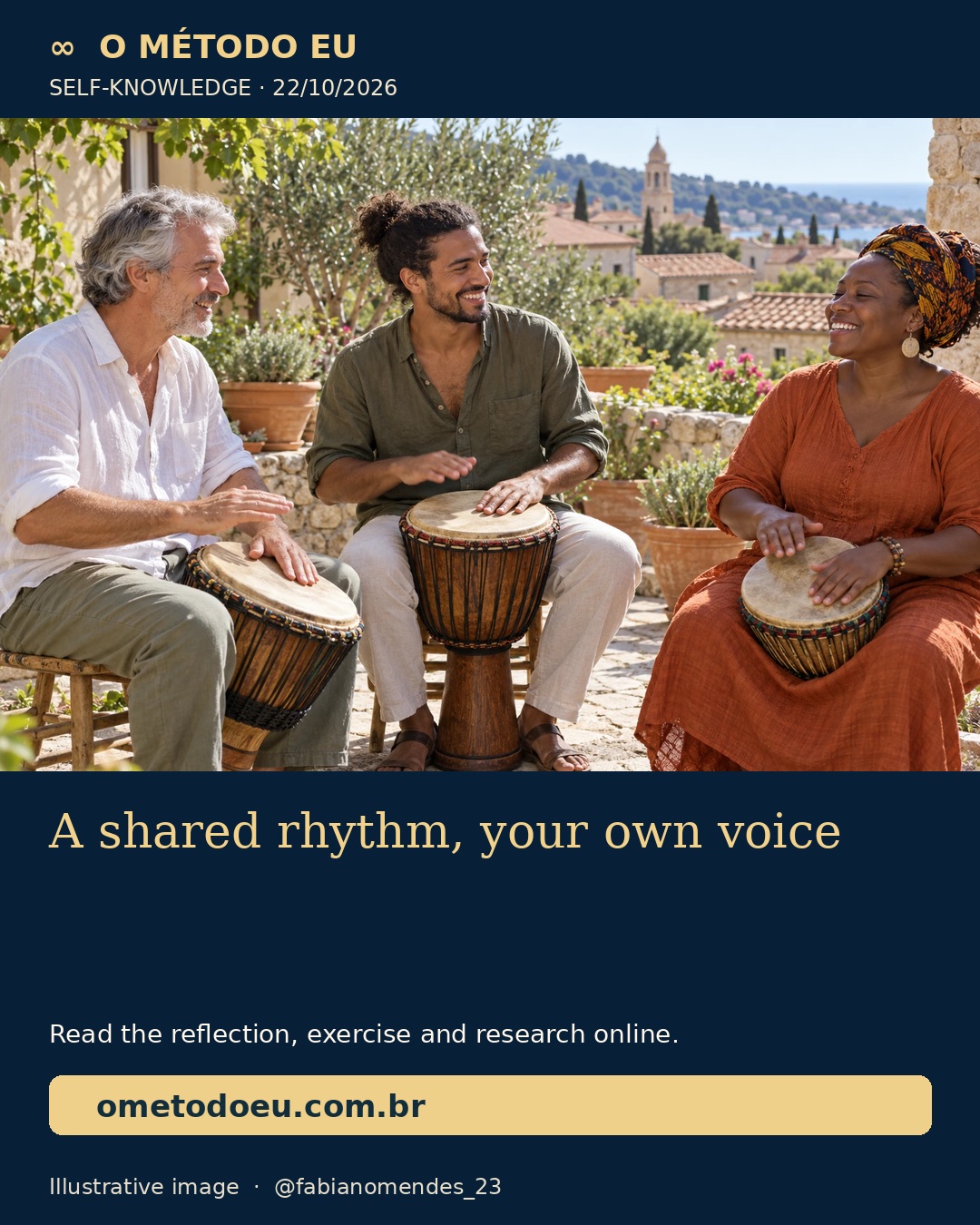
Outros livros, edições e lojas
- Read the free sample and view editions
- View this Portuguese edition on Amazon Brazil
- Read the free sample and view editions
- View this Portuguese edition on Amazon Brazil
- Consulte os benefícios Prime na AmazonCapa comum — ideal para a prática do métodoVer na Amazon Brasil ↗*Consulte a elegibilidade Prime e as condições de entrega na Amazon. Publicidade · link de associado.
- United States · English — The Me Method ↗
- France · Français ↗
- 🌐 Choose from 13 Amazon stores →
Share: WhatsApp, Instagram, image and link
Instagram: download the image and choose it from your gallery in Instagram. Copy the caption below; use the link sticker in Stories.