Documented story · 4 min de leitura
SELF-KNOWLEDGE · · 3 min read
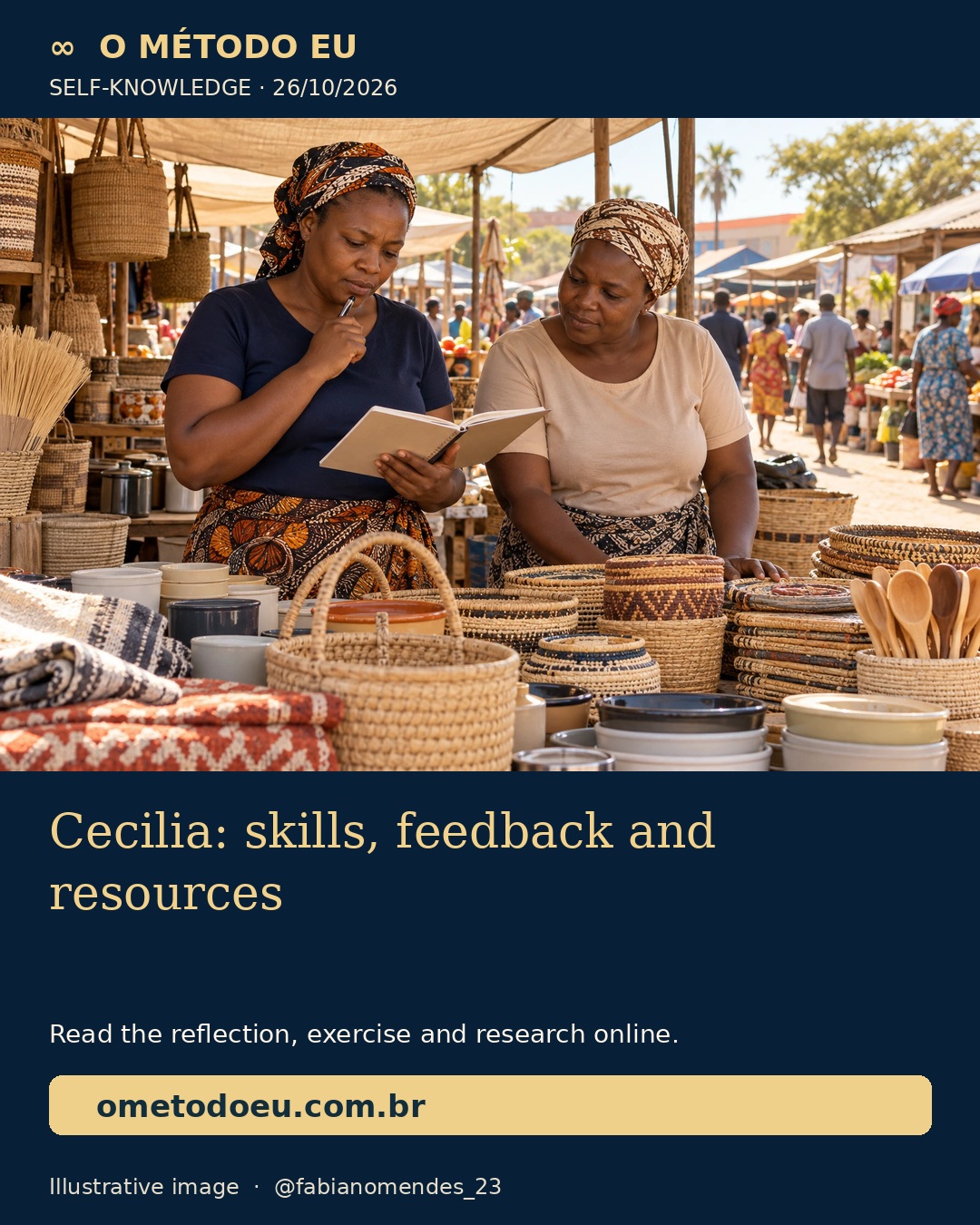
Cecilia: skills, feedback and resources

A business story often becomes a slogan about courage. Looking more closely can reveal questions about resources, learning and who is able to offer useful feedback. These details matter when deciding what a project actually needs.
Feedback is not automatically a lesson, and criticism is not automatically fair. You can examine specific information while keeping boundaries around disrespect. Changing a practice may require guidance and resources as well as a willingness to reconsider an assumption.
An exercise in noticing
Choose a small, low-stakes project. Write one piece of feedback as a specific observation, then separate what can be checked from what is merely a judgment. Identify one question and one resource you would need before changing the plan. Do not make purchases or financial commitments to complete this editorial exercise.
Question: Which part of the feedback gives you information you can actually check?
An educational editorial exercise, not a clinical protocol.What the research investigated
Lauren Eskreis-Winkler and Ayelet Fishbach, at the University of Chicago Booth School of Business, United States, reported five studies with 1,674 participants. In binary-choice tasks, both success and failure feedback revealed the correct answer, yet participants learned less from feedback on their own failures. Learning from another person’s outcomes did not show the same success–failure difference. The article was first published on 8 November 2019; a replication of Study 2a was preregistered.
Limitations: Structured short tasks do not reproduce the financial and social conditions of running a business. The findings do not establish what caused Cecilia’s learning or success, nor mean that every criticism is useful. Not every study was preregistered. The exercise and books were not evaluated, and no child-specific conclusion is offered.
Lauren Eskreis-Winkler; Ayelet Fishbach. Not Learning From Failure—the Greatest Failure of All. Psychological Science 30(12), 1733–1744. First online: 2019-11-08. DOI: 10.1177/0956797619881133.
Source checked on 26 October 2026. Earlier research revisited today; no claim of scientific novelty or evidence for the books.
Read the primary source →Original research date: 2019-11-08.
Documented real-life story
In an Africa Albinism Network interview published for International Women’s Day on 8 March 2025, Cecilia Paulus described selling perfumes, hair oils and secondhand clothes alongside her salaried work. She reported learning communication, negotiation and financial-management skills at a 2024 forum. She also described limited start-up capital, competition and discrimination. Her account makes both practical learning and barriers visible; it does not establish current earnings, business size or a formula others can reproduce.
Cecilia Paulus — Namibia · Africa Albinism Network original interview with Cecilia Paulus, 8 March 2025; independently paraphrased. Publication date also confirmed in the organization’s category index. · 2025-03-08
Read the original account →A published individual account; it does not establish causality, a universal cure or guaranteed results. It does not imply use or endorsement of O MÉTODO EU.Keywords: self-knowledge, learning, feedback, entrepreneurship
Download the Instagram image → · Copy or download the caption →
Editorial connection with O MÉTODO EU
O MÉTODO EU connects editorially with examining assumptions and distinguishing a possible change from the resources and conditions it requires.
A thematic connection made by the editorial team. These sources do not test the book’s effectiveness; the people mentioned are not presented as readers or endorsers of the book.Outros livros, edições e lojas
- Read the free sample and view editions
- View this Portuguese edition on Amazon Brazil
- Read the free sample and view editions
- View this Portuguese edition on Amazon Brazil
- Consulte os benefícios Prime na AmazonCapa comum — ideal para a prática do métodoVer na Amazon Brasil ↗*Consulte a elegibilidade Prime e as condições de entrega na Amazon. Publicidade · link de associado.
- United States · English — The Me Method ↗
- France · Français ↗
- 🌐 Choose from 13 Amazon stores →
Share: WhatsApp, Instagram, image and link
Instagram: download the image and choose it from your gallery in Instagram. Copy the caption below; use the link sticker in Stories.