SELF-KNOWLEDGE · · 3 min read
Which feedback is worth thinking about?

A comment about you can feel larger than the situation it describes. You may want to reject it immediately, or accept it as a complete verdict. Between those responses is room to ask what was observed, in which circumstances, and whether the person has enough information to make the claim.
Why this matters now
The ILO report Lifelong learning and skills for the future, published on 5 May 2026, discusses learning across workplaces and everyday settings, including peer support. It provides a current international context for examining how we learn from others. It does not validate this reflection exercise or show that every comment deserves to shape someone’s self-concept.
Read the context source →Reflection does not require agreement. It can lead you to adjust one belief, ask for an example or decide that the feedback is unsupported. Try to keep the scale of the conclusion close to the scale of the evidence. One difficult moment need not define an identity, and one flattering comment need not become a rule you must keep proving.
An exercise in noticing
Choose a recent, low-stakes piece of feedback from a reasonably trustworthy source. Write down the specific behavior described, one relevant example and one question about context. Ask whether the observation fits other situations before making a broad claim about yourself. You may leave the question open. Do not seek hostile criticism or treat degrading, coercive comments as an obligation to improve yourself.
Question: What concrete example would help you assess this feedback fairly?
An educational editorial exercise, not a clinical protocol.What the research investigated
Brotzeller, Spägele and Gollwitzer, at LMU Munich, Germany, examined reflection after feedback that differed from participants’ self-views. Five correlational studies involved 2,422 participants in total. A subsequent preregistered experiment with 1,149 participants encouraged reflection or used distraction; encouraging reflection produced a small increase in immediate self-concept change. The earlier studies’ analyses addressed questions different from their original preregistrations.
Limitations: Immediate self-reported change does not establish greater accuracy, lasting growth or better mental health. Some feedback was experimentally constructed. The findings do not imply that criticism is always valid or negative feedback is more helpful. This editorial exercise has not been tested as an intervention, and the studies did not evaluate these books.
Brotzeller, F.; Spägele, G. L.; Gollwitzer, M. I Think, Therefore I Change: Reflection Leads to Self-Concept Change After Discrepant Feedback. Personality and Social Psychology Bulletin, 52(7), July 2026; first published online 30 April 2025. DOI: 10.1177/01461672251333466.
Source checked on 21 October 2026. Earlier research revisited today; no claim of scientific novelty or evidence for the books.
Read the primary source →Entirely fictional example
Entirely fictional example: Marcus hears that he sometimes rushes through explanations. He asks a colleague for a concrete example and recalls one meeting where time was short. He considers slowing down in a similar meeting while keeping the broader question open. The scene is invented; it is not a research participant’s account or proof of a lasting change.
An invented example for reflection, not a research report, testimonial or evidence.Keywords: self-knowledge, feedback, reflection, self-concept, learning
Download the Instagram image → · Copy or download the caption →
Educational content for adults. It does not replace professional assessment or support.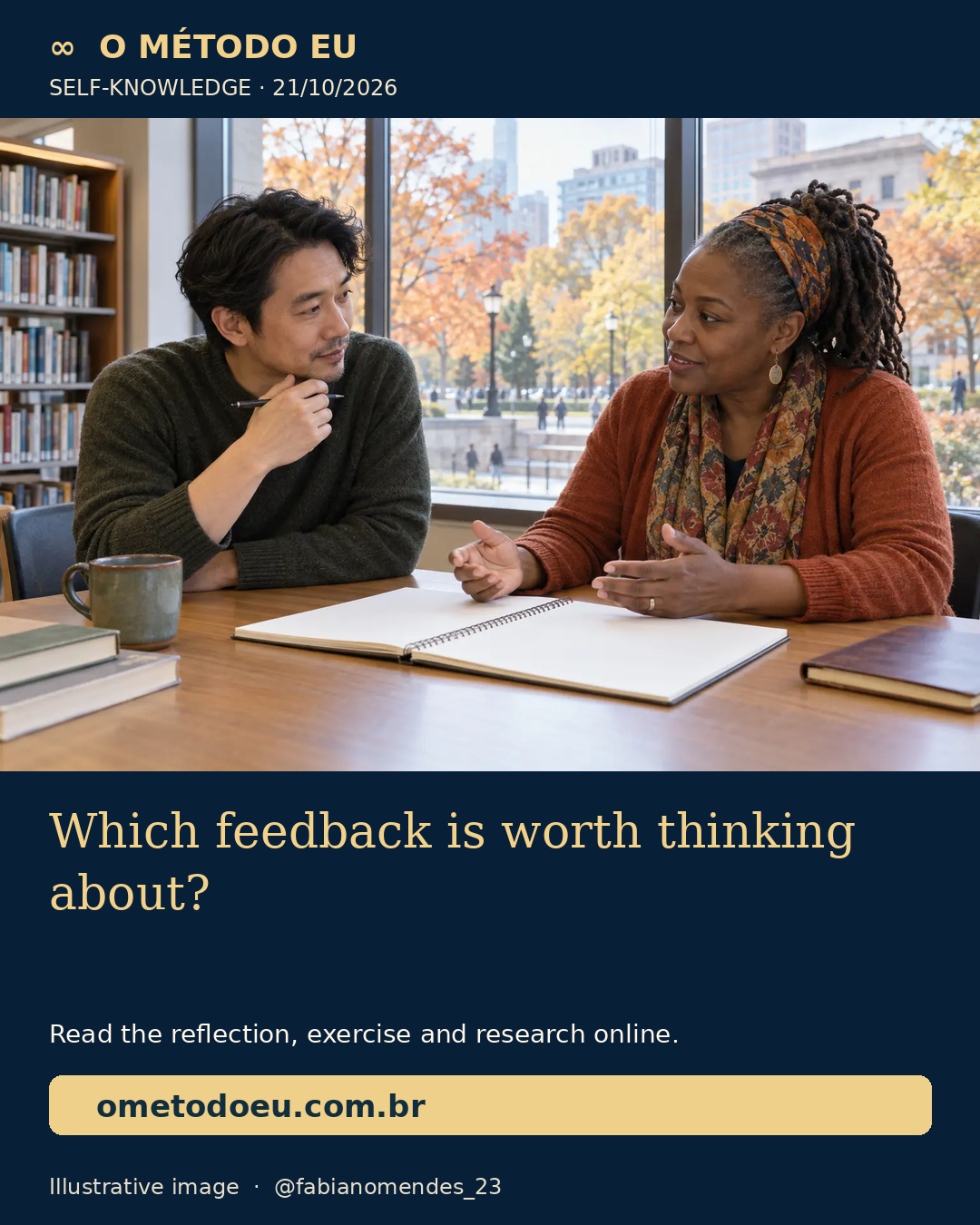
Outros livros, edições e lojas
- Read the free sample and view editions
- View this Portuguese edition on Amazon Brazil
- Read the free sample and view editions
- View this Portuguese edition on Amazon Brazil
- Consulte os benefícios Prime na AmazonCapa comum — ideal para a prática do métodoVer na Amazon Brasil ↗*Consulte a elegibilidade Prime e as condições de entrega na Amazon. Publicidade · link de associado.
- United States · English — The Me Method ↗
- France · Français ↗
- 🌐 Choose from 13 Amazon stores →
Share: WhatsApp, Instagram, image and link
Instagram: download the image and choose it from your gallery in Instagram. Copy the caption below; use the link sticker in Stories.