Research · 3 min de leitura
SELF-KNOWLEDGE · · 3 min read
Before the next swipe, notice what you need

You open a video for a break, then move to another before finding out whether the first one interests you. There can be good reasons to skip: an unwanted subject, poor information or simply a different preference. The useful question is what you are hoping the next swipe will provide.
A pause does not have to become another rule to obey. You can keep watching, choose something else or leave the screen. Noticing your intention may help distinguish a chosen activity from a sequence you have continued without deciding. It does not turn boredom into a personal failure.
An exercise in noticing
During an ordinary, optional media break, briefly name what you want: entertainment, information, company or rest. Choose whether to watch one suitable item, change it deliberately or stop. Never stay with upsetting or unsafe content to complete this prompt. Adult editorial reflection, not a digital detox, clinical intervention or test of willpower.
Question: What are you asking the next swipe to change?
An educational editorial exercise, not a clinical protocol.What the research investigated
Katy Y. Y. Tam and Michael Inzlicht, University of Toronto, Canada, reported seven experiments with 1,223 participants, six preregistered. Video experiments found that switching between or within videos could increase boredom rather than reduce it, alongside lower satisfaction and attention. Some samples were university students. First online: 19 August 2024; journal issue: October 2024.
Limitations: Findings were less conclusive for online articles and nonuniversity samples, and some results depended on order. These tasks do not establish effects for every platform, person or age, or long-term clinical outcomes. They did not test the books or this exercise and do not justify child-specific advice.
Katy Y. Y. Tam; Michael Inzlicht. Fast-Forward to Boredom: How Switching Behavior on Digital Media Makes People More Bored. Journal of Experimental Psychology: General 153(10), 2409–2426. First online: 2024-08-19. DOI: 10.1037/xge0001639.
Source checked on 30 October 2026. Earlier research revisited today; no claim of scientific novelty or evidence for the books.
Read the primary source →Original research date: 2024-08-19.
Entirely fictional example
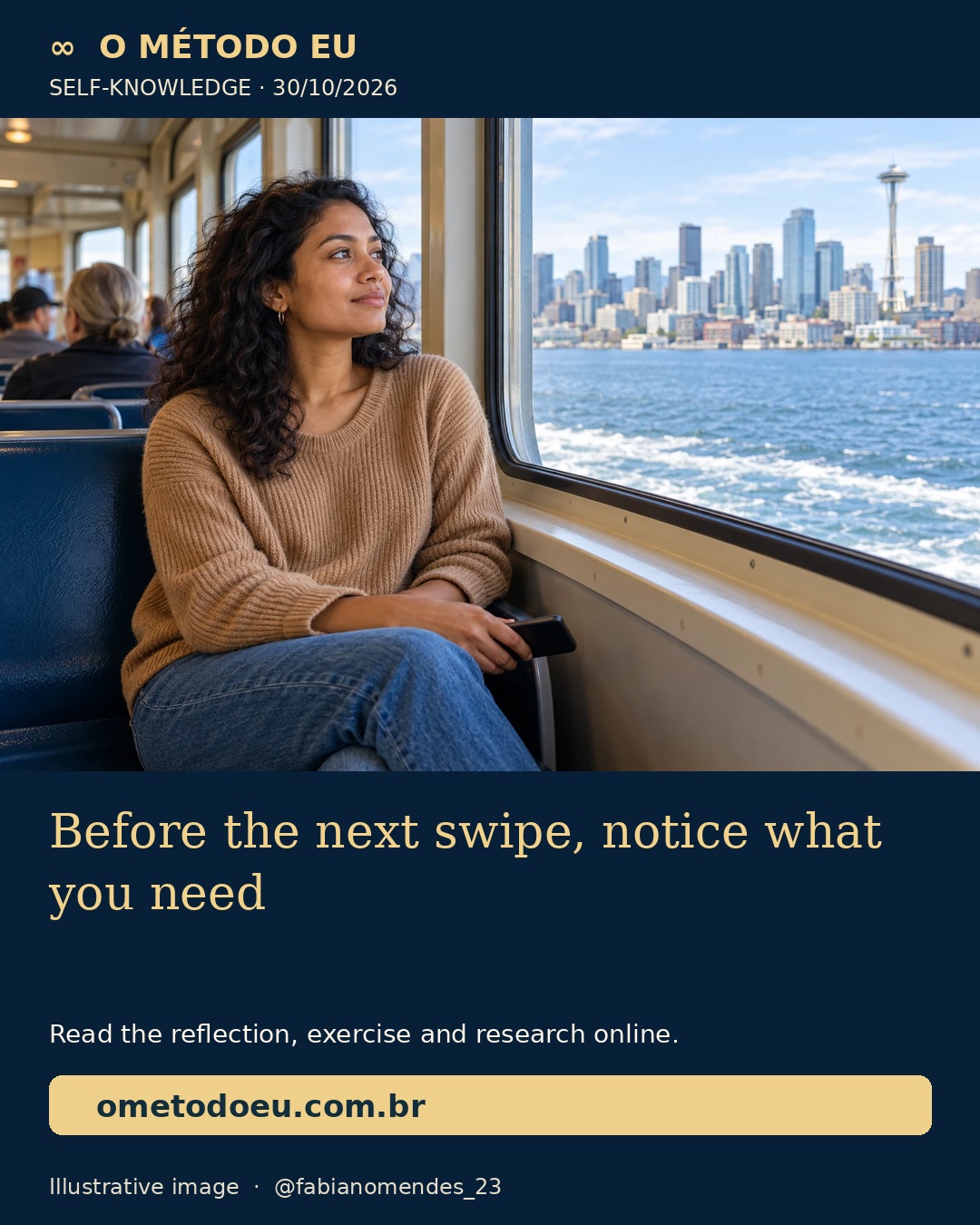
Entirely fictional example: Noor notices she has skipped several videos while waiting for a ferry. She decides she wants a screen break and looks outside. The scene does not claim that her boredom or attention improved; she is not a study participant.
An invented example for reflection, not a research report, testimonial or evidence.Keywords: self-knowledge, digital habits, boredom, attention
Download the Instagram image → · Copy or download the caption →
Editorial connection with O MÉTODO EU
The editorial connection with O MÉTODO EU is noticing an automatic response and asking which need your next choice is meant to address. The research is independent and does not test the book’s effectiveness.
A thematic connection made by the editorial team. These sources do not test the book’s effectiveness; the people mentioned are not presented as readers or endorsers of the book.Outros livros, edições e lojas
- Read the free sample and view editions
- View this Portuguese edition on Amazon Brazil
- Read the free sample and view editions
- View this Portuguese edition on Amazon Brazil
- Consulte os benefícios Prime na AmazonCapa comum — ideal para a prática do métodoVer na Amazon Brasil ↗*Consulte a elegibilidade Prime e as condições de entrega na Amazon. Publicidade · link de associado.
- United States · English — The Me Method ↗
- France · Français ↗
- 🌐 Choose from 13 Amazon stores →
Share: WhatsApp, Instagram, image and link
Instagram: download the image and choose it from your gallery in Instagram. Copy the caption below; use the link sticker in Stories.