Research · 3 min de leitura
SELF-KNOWLEDGE · · 3 min read
Ask before assuming you understand

You may know someone well and still be uncertain about what they want in a particular situation. Filling that gap with your own explanation can feel considerate while leaving the person’s actual preference unheard. A respectful question makes room for information you do not have.
Asking is not a demand for disclosure. Another person may prefer to pause, keep a subject private or change their mind. Understanding remains partial, and a conversation does not grant permission to decide for someone else.
An exercise in noticing
In a safe, ordinary conversation with another adult, identify a preference you are assuming and ask whether you understood it correctly. Leave room for a correction, a short answer or no answer. Afterwards, note what you learned and what remains uncertain. This editorial prompt is not a validated intervention or a test of empathy.
Question: What could you ask instead of treating your interpretation as their answer?
An educational editorial exercise, not a clinical protocol.What the research investigated
Tal Eyal, Mary Steffel and Nicholas Epley, affiliated with Ben-Gurion University (Israel), Northeastern and Chicago (USA), reported 25 experiments with adults. Instructions to imagine another person’s perspective did not consistently improve accuracy about emotions, attitudes or preferences. In a final experiment, obtaining information through conversation improved accuracy. The journal issue is April 2018; Ben-Gurion’s institutional publication record gives 1 April 2018.
Limitations: Specific prediction tasks and selected samples do not represent every relationship or conflict. This does not show that empathy lacks value or that every conversation yields complete understanding. No child-specific, clinical, book or editorial-exercise efficacy was established. The institutional date is not asserted as a verified first-online day.
Tal Eyal; Mary Steffel; Nicholas Epley. Perspective mistaking: Accurately understanding the mind of another requires getting perspective, not taking perspective. Journal of Personality and Social Psychology 114(4), 547–571, April 2018. Institutional record date: 2018-04-01. DOI: 10.1037/pspa0000115.
Source checked on 29 October 2026. Earlier research revisited today; no claim of scientific novelty or evidence for the books.
Read the primary source →Original research date: 2018-04-01.
Entirely fictional example
Entirely fictional example: Maya assumes a friend wants advice about a plan. She asks and learns that the friend only wants someone to listen. She follows that preference. This invented scene is not a participant or evidence of a guaranteed relationship benefit.
An invented example for reflection, not a research report, testimonial or evidence.Keywords: self-knowledge, perspective, listening, relationships
Download the Instagram image → · Copy or download the caption →
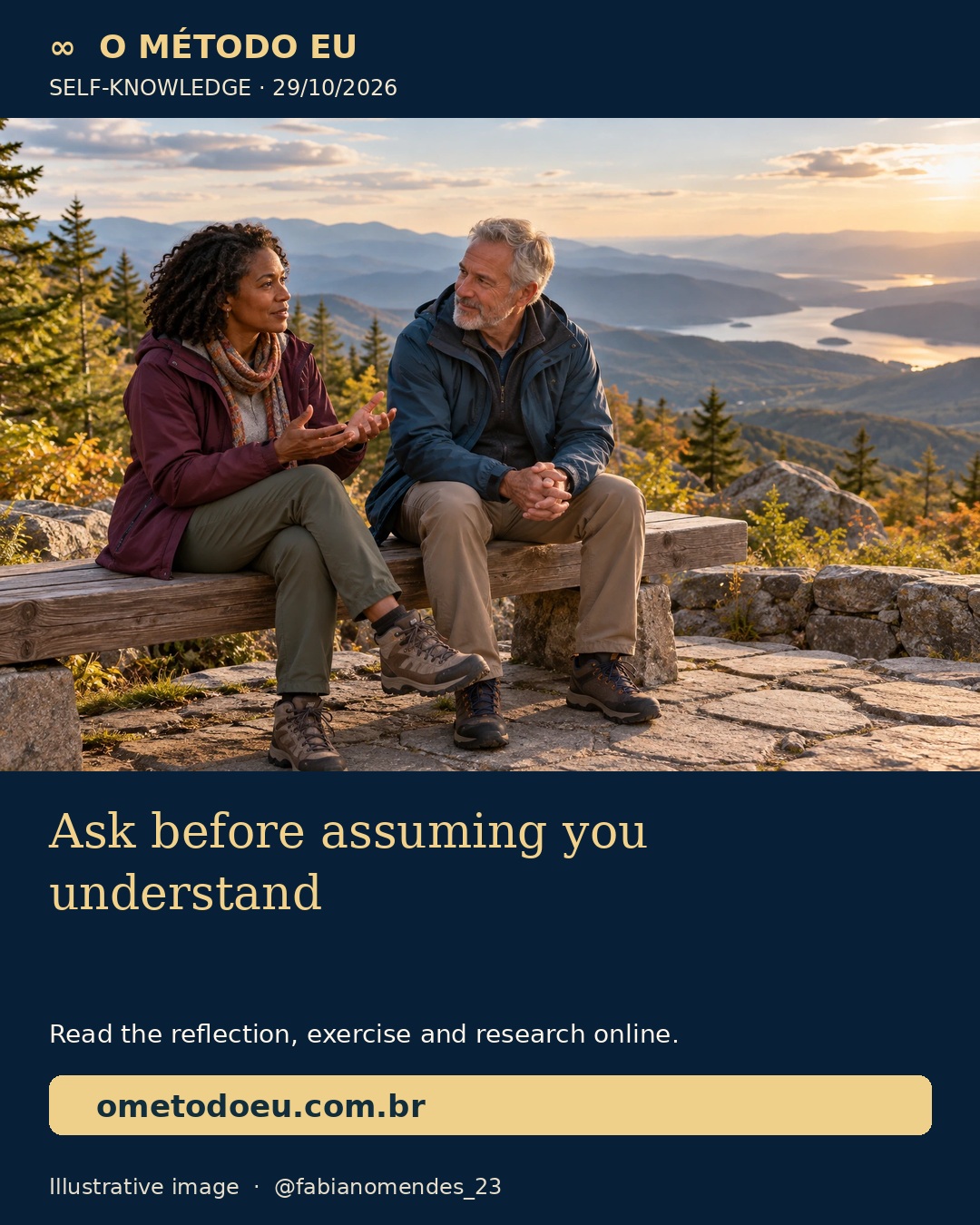
Editorial connection with O MÉTODO EU
The editorial connection with O MÉTODO EU is examining an assumption and recognizing the limits of your own interpretation before choosing how to respond.
A thematic connection made by the editorial team. These sources do not test the book’s effectiveness; the people mentioned are not presented as readers or endorsers of the book.Outros livros, edições e lojas
- Read the free sample and view editions
- View this Portuguese edition on Amazon Brazil
- Read the free sample and view editions
- View this Portuguese edition on Amazon Brazil
- Consulte os benefícios Prime na AmazonCapa comum — ideal para a prática do métodoVer na Amazon Brasil ↗*Consulte a elegibilidade Prime e as condições de entrega na Amazon. Publicidade · link de associado.
- United States · English — The Me Method ↗
- France · Français ↗
- 🌐 Choose from 13 Amazon stores →
Share: WhatsApp, Instagram, image and link
Instagram: download the image and choose it from your gallery in Instagram. Copy the caption below; use the link sticker in Stories.