Research
SELF-KNOWLEDGE · · 3 min read
What feels good while you move?

You finish a walk relieved that it is over. The next day, you take a quieter route and find yourself enjoying part of it. Both walks took about the same time. If you record only the minutes, you miss something you might want to know before choosing where to go next.
Pay attention to the difference between what you felt during the activity and how you felt afterward. You might enjoy one stretch and feel tired at the end, or feel reluctant at first and glad later. Either observation can help you describe the conditions under which movement fits your day. It does not tell you what someone else should do.
An exercise in noticing
If a familiar form of movement already suits you, choose one ordinary occasion and jot down how it felt during the activity and just after it. Note one detail, such as company, route, sound or time of day. On another occasion, see what you notice when one detail is different. You can do this with movement already in your day; there is no need to increase duration or effort.
Question: What detail would you keep if you wanted the activity to feel more inviting next time?
An educational editorial exercise, not a clinical protocol.What the research investigated
Jiao Liu, Wen-Jing Liu, Yue Qiu and Zhi-Xiong Mao, affiliated with institutions in Beijing and Chengdu, China, ran a preregistered trial with 97 adults who were not sufficiently active and were considering or preparing to exercise. Participants were randomly assigned to four weeks of low- to moderate-intensity exercise with guided mindfulness audio, a neutral podcast or no audio. The guided group reported more pleasant feelings during exercise than the other groups. Enjoyment afterward and intention to exercise were higher than in the podcast group, with smaller or statistically unclear differences versus the no-audio group. Exercise behavior rose after the program and fell at the one-month follow-up, although it remained above baseline.
Limitations: The trial tested a specific program in a small group of adults who were already considering exercise. The follow-up lasted one month, and the immediate improvement in behavior was not maintained at the same level. The results do not establish a long-term habit, a clinical effect or a benefit of listening to just any audio. The walking reflection here was not tested by the researchers.
Liu J, Liu W-J, Qiu Y, Mao Z-X. Mindful exercise intervention on exercise affect and behavior: A randomized controlled trial. Applied Psychology: Health and Well-Being, 18(3), e70153. DOI: 10.1111/aphw.70153.
Source checked on 13 November 2026. Earlier research revisited today; no claim of scientific novelty or evidence for the books.
Read the primary source →Original research date: 2026-05-12.
Entirely fictional example
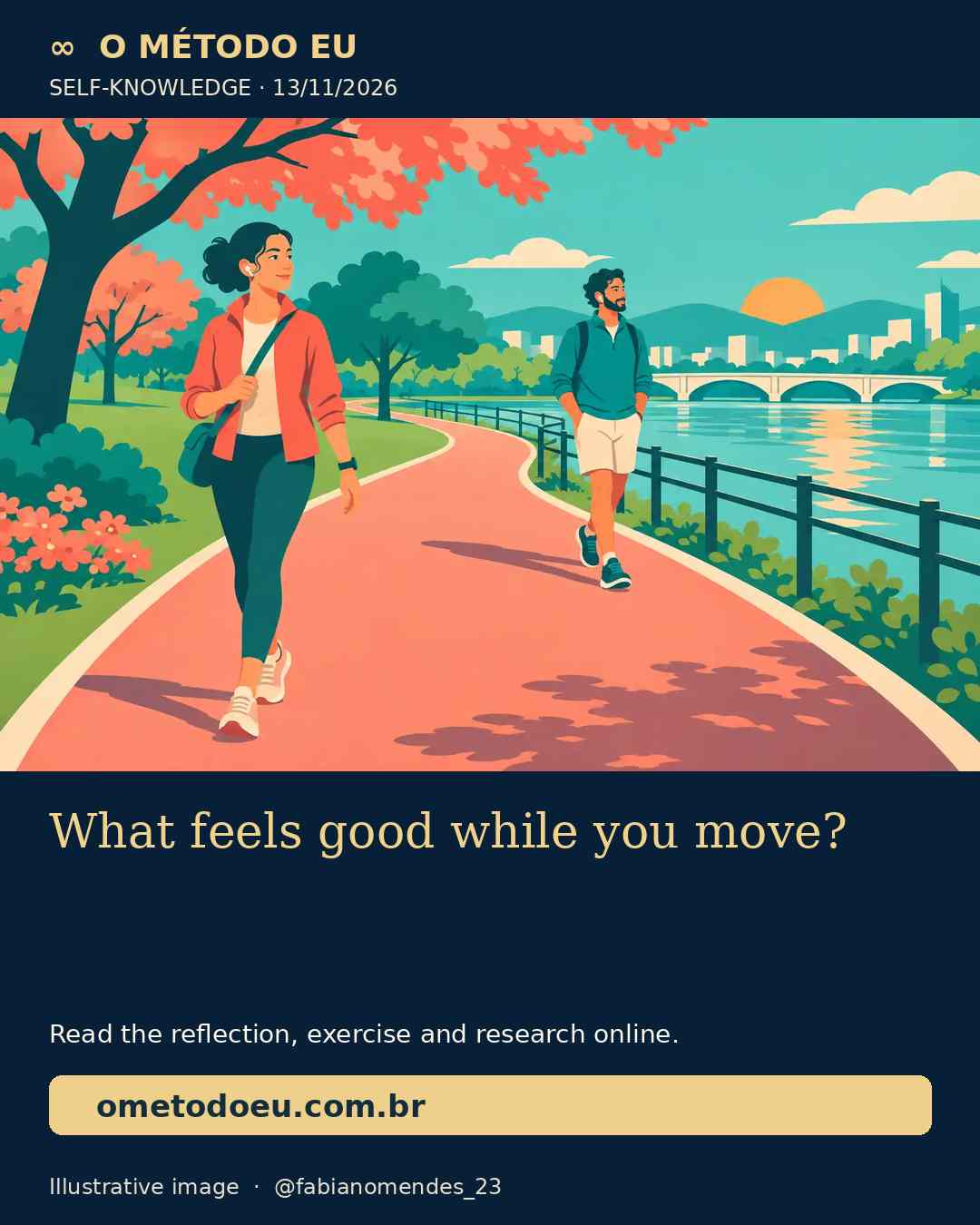
Entirely fictional example: Devon usually walks beside a busy road. One day, the riverside path is open, so they take it instead. At the end Devon feels about as tired as usual, but remembers enjoying the quiet stretch by the water. They make a note of that stretch rather than deciding that every future walk will feel the same.
An invented example for reflection, not a research report, testimonial or evidence.Keywords: self-knowledge, movement, exercise enjoyment, mindfulness, everyday habits
Download the Instagram image → · Copy or download the caption →
Editorial connection with O MÉTODO EU
The editorial link to O MÉTODO EU is to observe an experience before making a judgment about your habits. Distinguishing how an activity feels from what you intend to do next gives you a more precise starting point for reviewing a routine. The study did not test the book.
A thematic connection made by the editorial team. These sources do not test the book’s effectiveness; the people mentioned are not presented as readers or endorsers of the book.Outros livros, edições e lojas
- Read the free sample and view editions
- View this Portuguese edition on Amazon Brazil
- Read the free sample and view editions
- View this Portuguese edition on Amazon Brazil
- Consulte os benefícios Prime na AmazonCapa comum — ideal para a prática do métodoVer na Amazon Brasil ↗*Consulte a elegibilidade Prime e as condições de entrega na Amazon. Publicidade · link de associado.
- United States · English — The Me Method ↗
- France · Français ↗
- 🌐 Choose from 13 Amazon stores →
Share: WhatsApp, Instagram, image and link
Instagram: download the image and choose it from your gallery in Instagram. Copy the caption below; use the link sticker in Stories.