Research · 4 min de leitura
SELF-KNOWLEDGE · · 3 min read
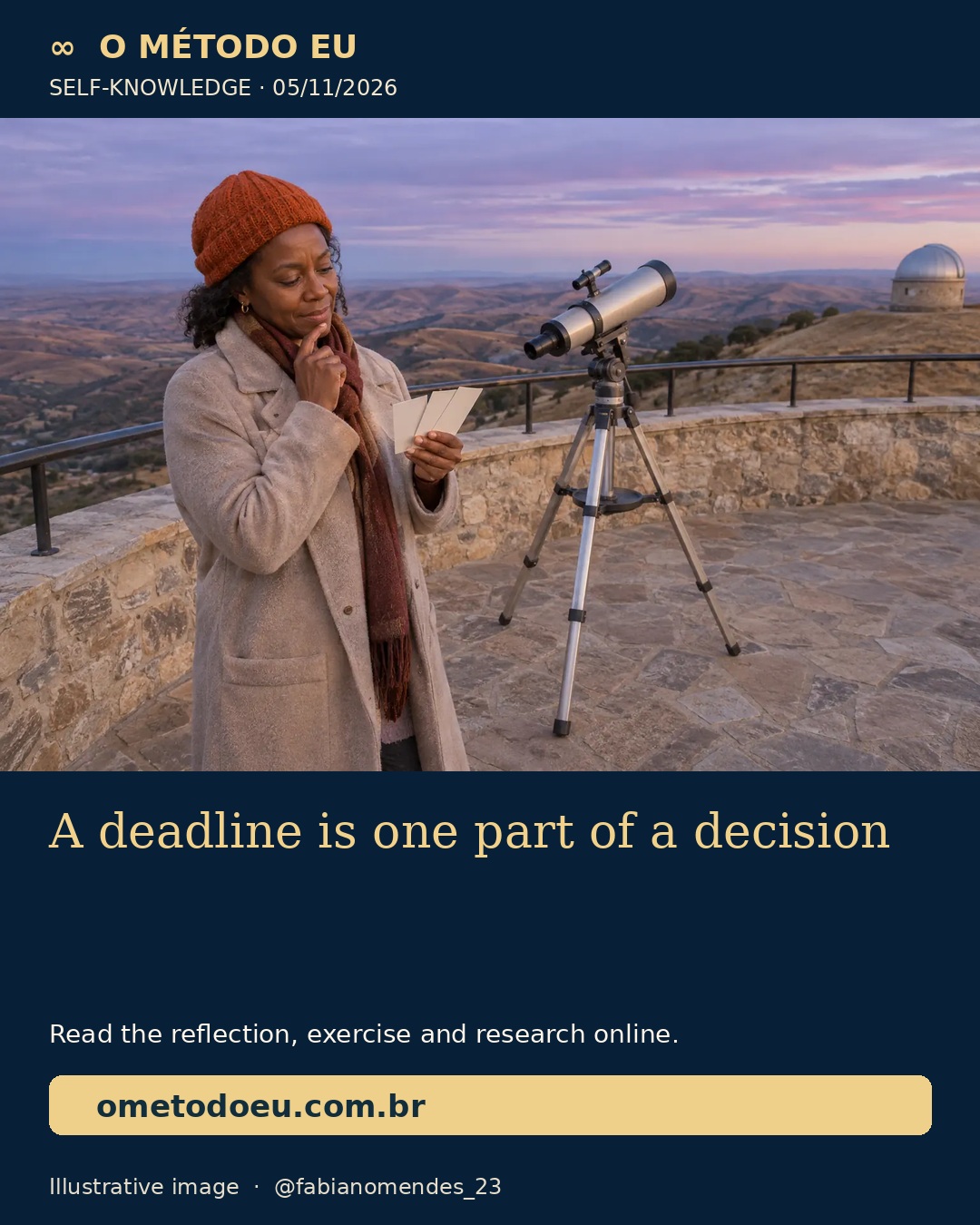
A deadline is one part of a decision

An approaching deadline can give a task a clear place in your day. It can also make a small request feel larger than everything around it. Before moving it to the top of your list, ask what will actually happen when the deadline arrives and what completing the task would contribute.
The answer may be to act now: some commitments really do need a timely response. In another situation, you may have room to compare options. Noticing the difference is a practical form of self-observation. It lets you describe the reason for a choice instead of relying only on the feeling that something must be done immediately.
An exercise in noticing
Choose two optional, low-stakes tasks. Write down each genuine deadline, any consequence of waiting and one reason the task matters. Then choose an order and state your reason in one sentence. This adult editorial exercise was not the study intervention. Keep established arrangements for safety, healthcare and other critical obligations; they are outside this exercise.
Question: What makes your next task important, beyond the feeling that time is running out?
An educational editorial exercise, not a clinical protocol.What the research investigated
Richard Mills, Robin Cubitt and Chris Starmer, University of Nottingham, UK, reported independent replications totaling 2,374 participants. Paid online task-choice experiments tested whether illusory urgency encouraged choosing a lower-payoff option. They used a close replication, designs addressing possible confounds, a new setup and a synthesis across replications. Added controls reduced the effect, but it remained significant in the confound-control tests. First publication: September 18, 2026.
Limitations: These are choices within a particular experimental paradigm, not evidence that real deadlines are unimportant. The public abstract does not establish globally representative sampling or long-term benefits from a planning routine. This exercise, clinical decisions and children's behaviour were not evaluated.
Richard Mills; Robin Cubitt; Chris Starmer. Brief Commentary: An Independent Replication Study of the Mere Urgency Effect. Journal of Consumer Research, ucag026. First published: 2026-09-18; typeset: 2026-09-24. DOI: 10.1093/jcr/ucag026.
Source checked on 05 November 2026. Earlier research revisited today; no claim of scientific novelty or evidence for the books.
Read the primary source →Original research date: 2026-09-18.
Entirely fictional example
Entirely fictional example: Asha is arranging a weekend astronomy outing. She notices an optional form marked as closing soon while the group still needs to agree on a meeting place. She checks whether the form changes the outing and then decides what to do first. Asha is invented; the scene does not illustrate a measured outcome.
An invented example for reflection, not a research report, testimonial or evidence.Keywords: self-knowledge, urgency, decision making, priorities, task choice
Download the Instagram image → · Copy or download the caption →
Editorial connection with O MÉTODO EU
The editorial connection to O MÉTODO EU is noticing a familiar reaction to time pressure and making the reason for a choice explicit. The independent researchers did not test or endorse the book, and the reflection does not claim that it improves decision outcomes.
A thematic connection made by the editorial team. These sources do not test the book’s effectiveness; the people mentioned are not presented as readers or endorsers of the book.Outros livros, edições e lojas
- Read the free sample and view editions
- View this Portuguese edition on Amazon Brazil
- Read the free sample and view editions
- View this Portuguese edition on Amazon Brazil
- Consulte os benefícios Prime na AmazonCapa comum — ideal para a prática do métodoVer na Amazon Brasil ↗*Consulte a elegibilidade Prime e as condições de entrega na Amazon. Publicidade · link de associado.
- United States · English — The Me Method ↗
- France · Français ↗
- 🌐 Choose from 13 Amazon stores →
Share: WhatsApp, Instagram, image and link
Instagram: download the image and choose it from your gallery in Instagram. Copy the caption below; use the link sticker in Stories.