Documented story
SELF-KNOWLEDGE · · 3 min read
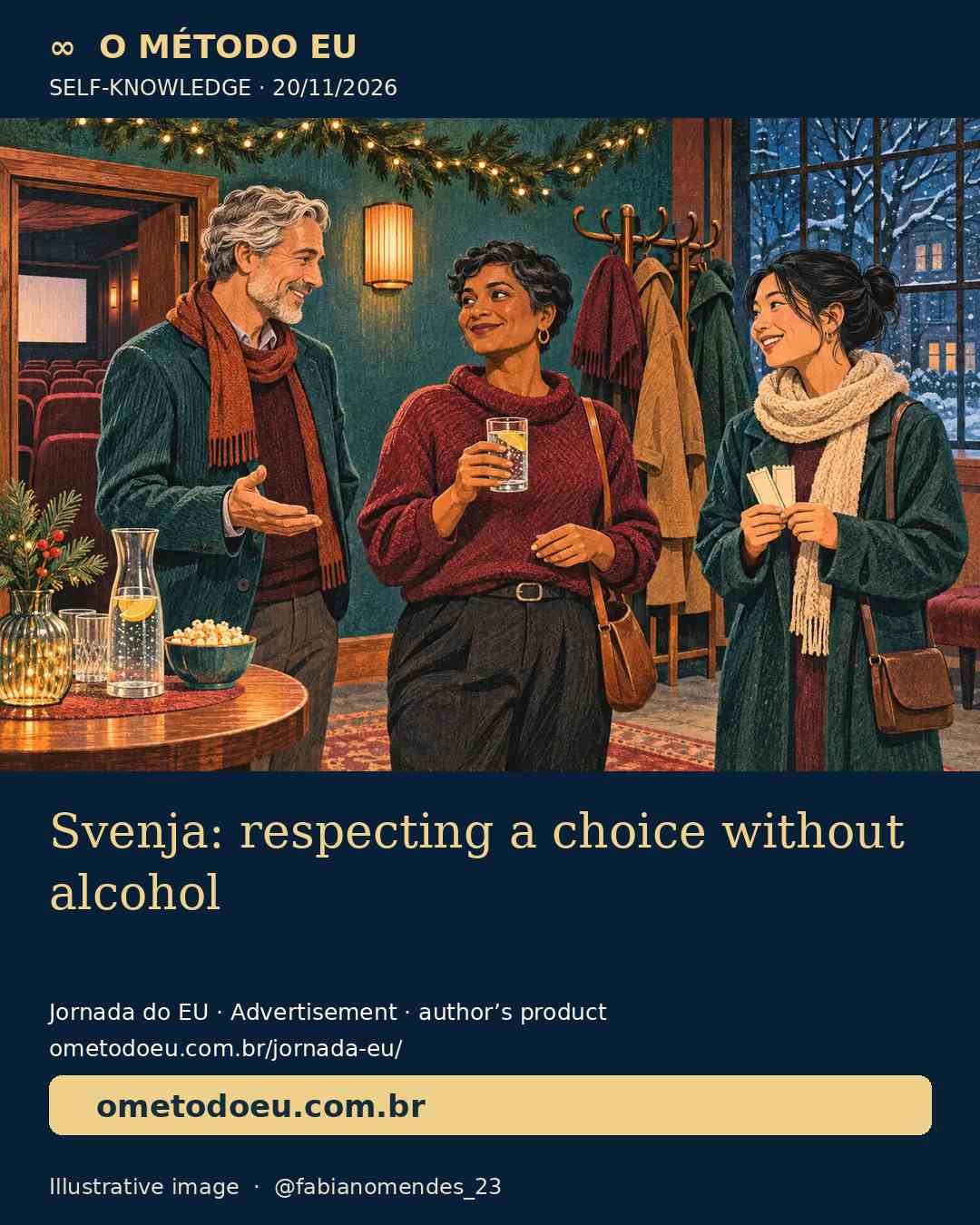
Svenja: respecting a choice without alcohol

Belonging can become conditional when a group treats one kind of drink as proof that someone is joining in. A different question leaves more room: how can we enjoy being together while respecting a choice that is not ours to explain?
The values in this reflection are dignity, hospitality and consent. They can matter to people of different faiths and to people with no religion. Svenja’s account does not tell us her spiritual beliefs, and we do not assign any to her. Our interpretation is about the space a group can make for someone’s boundary.
A personal story can open a conversation without becoming an instruction. Stopping alcohol can require professional assessment and support, particularly when dependence or withdrawal is possible. The fact that one person describes stopping in a certain way does not make that route appropriate or safe for everybody.
An exercise in noticing
Separate Christmas editorial invitation for adults: if you are hosting, write one welcoming sentence that does not ask anyone to justify what they drink. If you are attending, identify a trusted person you could speak to privately about a boundary. You can keep your note private. Those who do not celebrate, feel lonely or are grieving can use an ordinary meeting instead. This is not a withdrawal plan or an alcohol-use treatment.
Question: How could your next invitation make someone feel welcome without asking them to override a personal boundary?
An educational editorial exercise, not a clinical protocol.What the research investigated
Independent of Svenja’s account, Carmen V. Voogt, Emmanuel Kuntsche, Marloes Kleinjan and Rutger C. M. E. Engels studied 907 heavy-drinking students in the Netherlands (mean age 20.8). A 2010–2011 randomized trial compared a brief web intervention with assessment only across 30 measurement points. The intervention group reported greater confidence refusing drinks under social pressure, persisting at six months. Higher refusal confidence was associated with lower drinking measures.
Limitations: The study used self-reported student data and had 17.9% attrition at six months. It does not establish that confidence alone caused drinking changes or explain Svenja’s decision. It is historical evidence, not a new 2026 result or advice for managing dependence. The research and personal account do not evaluate our exercise, books or course.
Voogt, C. V.; Kuntsche, E.; Kleinjan, M.; Engels, R. C. M. E. The effect of the “What Do You Drink” web-based brief alcohol intervention on self-efficacy to better understand changes in alcohol use over time: randomized controlled trial using ecological momentary assessment. Drug and Alcohol Dependence 138,89–97. Online 20 February 2014; issue 1 May 2014. DOI:10.1016/j.drugalcdep.2014.02.009.
Source checked on 20 November 2026. Earlier research revisited today; no claim of scientific novelty or evidence for the books.
Read the primary source →Original research date: 2014-02-20.
Documented real-life story
WHO Europe published Svenja’s first-person account on 7 March 2025. Then 24 and working in Berlin, she described deciding to stop drinking roughly two years earlier after noticing unwanted effects on her well-being. She recalled initial pressure to drink, followed by more curiosity and acceptance. WHO states that she shared her story for its Redefine Alcohol campaign and directs people experiencing alcohol-related harms to professional support. We report her experience as it was published, not her current health or drinking status, and do not infer dependence, treatment history or a cure.
Svenja Rossig — Germany, as identified in her WHO Europe account · Public personal account shared by Svenja with WHO Europe for the Redefine Alcohol campaign, published 7 March 2025. Reported experiences are attributed to her; no diagnosis, religion, endorsement or present-day clinical state is inferred. · 2025-03-07
Read the original account →A published individual account; it does not establish causality, a universal cure or guaranteed results. It does not imply use or endorsement of O MÉTODO EU.Keywords: self-knowledge, dignity, boundaries, hospitality, alcohol, Christmas
Download the Instagram image → · Copy or download the caption →
Editorial connection with O MÉTODO EU
In dialogue with O MÉTODO EU, the editorial question is how to recognize personal limits while respecting another person’s choices. Neither Svenja nor the researchers are presented as endorsing the books or the Jornada do EU.
A thematic connection made by the editorial team. These sources do not test the book’s effectiveness; the people mentioned are not presented as readers or endorsers of the book.Enjoyed the sample? Choose your edition on Amazon and order your copy.
Educational content for adults. It does not replace professional assessment or support.Share: WhatsApp, Instagram, image and link
Instagram: download the image and choose it from your gallery in Instagram. Copy the caption below; use the link sticker in Stories.