Documented story
SELF-KNOWLEDGE · · 3 min read
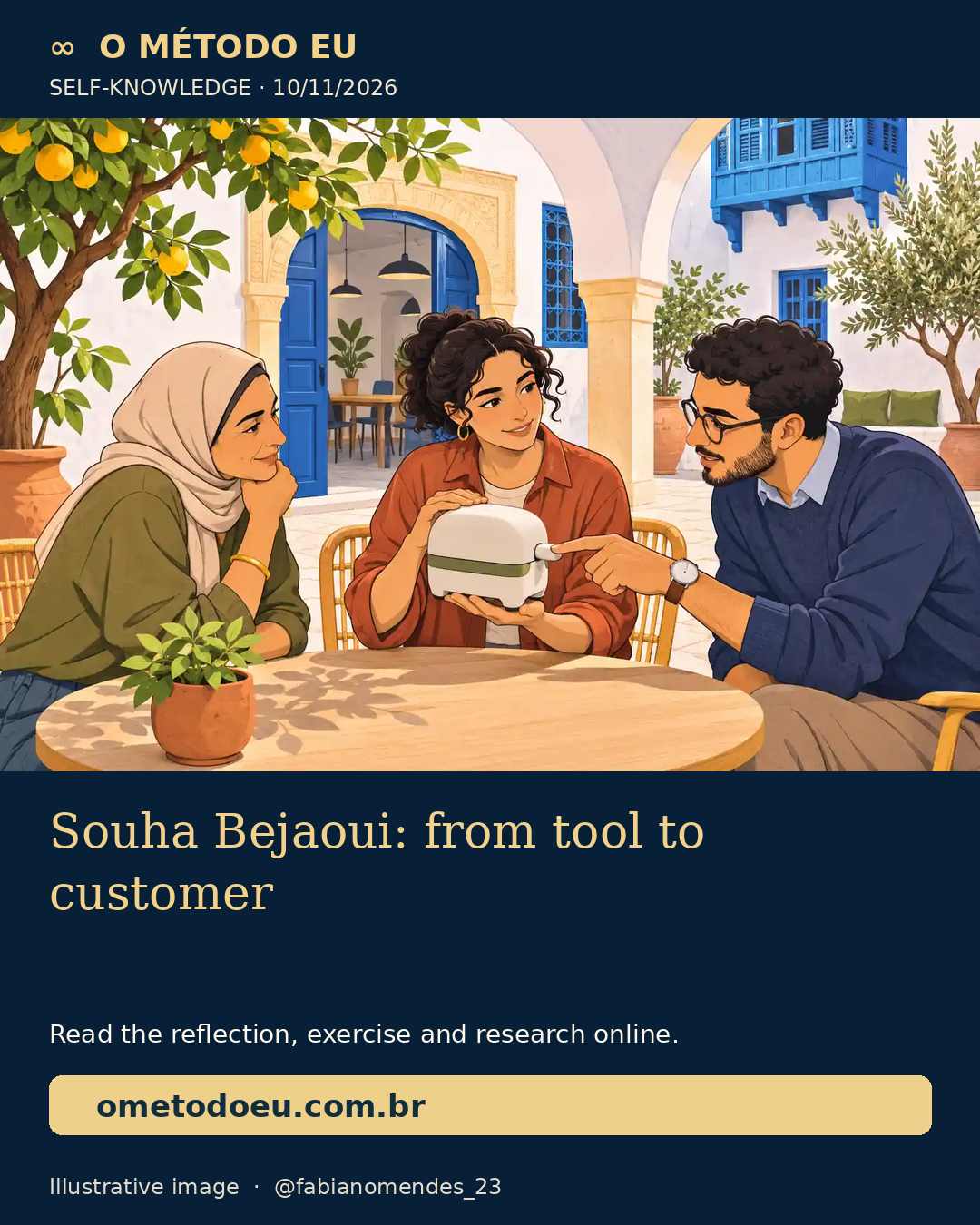
Souha Bejaoui: from tool to customer

A tool can do what you designed it to do and still leave a customer wondering where it fits into their day. Souha Bejaoui's account of building ProVerdy draws attention to the work that begins after a prototype exists. She described learning how to approach potential clients and talk through what they needed.
If you are building something, ask someone to show you how they handle the task now. Where does the work slow down? What would make switching to a new tool difficult? You might discover that a feature you considered secondary solves a problem they face every week. You might also find that keeping their current routine makes sense.
An exercise in noticing
Pick a low-risk project you know well. Write one sentence describing the task it is meant to make easier, then write a question you could ask a willing user about the last time they did that task. Listen to their account before describing your idea. Note what you might revise and what you still need to check. This is an educational exercise for adults, not the study protocol.
Question: What could someone show you about their day that would change what you build next?
An educational editorial exercise, not a clinical protocol.What the research investigated
Simone Santamaria, Niloofar Abolfathi and Ishtiaq Pasha Mahmood randomly assigned 236 early-stage entrepreneurs in Singapore to two versions of a six-month programme. The first five workshops emphasised either investigating prospective customers' needs or identifying resources and capabilities the entrepreneurs could build on. At programme end, ventures in the customer-focused group had acquired more than twice as many customers and reported higher revenues than those in the comparison group.
Limitations: Both groups received training. The contrast was between two early workshop approaches in one programme, not between listening to customers and ignoring them. Some participants did not report their outcomes. The results describe the programme period and do not establish durable profitability or what happened at ProVerdy.
Simone Santamaria, Niloofar Abolfathi and Ishtiaq Pasha Mahmood. Demand pull versus resource push training approaches to entrepreneurship: A field experiment. Strategic Management Journal 45(3), 564–587. First published online October 25, 2023; issue March 2024. DOI: 10.1002/smj.3560.
Source checked on 10 November 2026. Earlier research revisited today; no claim of scientific novelty or evidence for the books.
Read the primary source →Original research date: 2023-10-25.
Documented real-life story
In an August 2026 interview with the United Nations Development Programme, Souha Bejaoui described co-founding ProVerdy with Rahma Abida and Hamza Bêjaoui. The team built software for carbon accounting and sustainability reporting. Bejaoui said that coaching during the accelerator helped the founders work out whom to approach and how to negotiate. She also described how conversations and presentations led to an early customer, Banque de Tunisie. These are accounts of steps the team took, not a finding that any single step caused the company's results.
Souha Bejaoui — co-founder of ProVerdy, Tunisia · Original interview with Souha Bejaoui published by the United Nations Development Programme on August 13, 2026. · 2026-08-13
Read the original account →A published individual account; it does not establish causality, a universal cure or guaranteed results. It does not imply use or endorsement of O MÉTODO EU.Keywords: self-knowledge, entrepreneurship, user research, customer feedback, testing assumptions
Download the Instagram image → · Copy or download the caption →
Editorial connection with O MÉTODO EU
The editorial link to O MÉTODO EU is examining an assumption you are attached to and deciding what evidence would make you revise it. Neither Bejaoui's interview nor the field experiment evaluated or endorsed the book.
A thematic connection made by the editorial team. These sources do not test the book’s effectiveness; the people mentioned are not presented as readers or endorsers of the book.Outros livros, edições e lojas
- Read the free sample and view editions
- View this Portuguese edition on Amazon Brazil
- Read the free sample and view editions
- View this Portuguese edition on Amazon Brazil
- Consulte os benefícios Prime na AmazonCapa comum — ideal para a prática do métodoVer na Amazon Brasil ↗*Consulte a elegibilidade Prime e as condições de entrega na Amazon. Publicidade · link de associado.
- United States · English — The Me Method ↗
- France · Français ↗
- 🌐 Choose from 13 Amazon stores →
Share: WhatsApp, Instagram, image and link
Instagram: download the image and choose it from your gallery in Instagram. Copy the caption below; use the link sticker in Stories.