Research · 4 min de leitura
SELF-KNOWLEDGE · · 3 min read
A meeting has more than one job
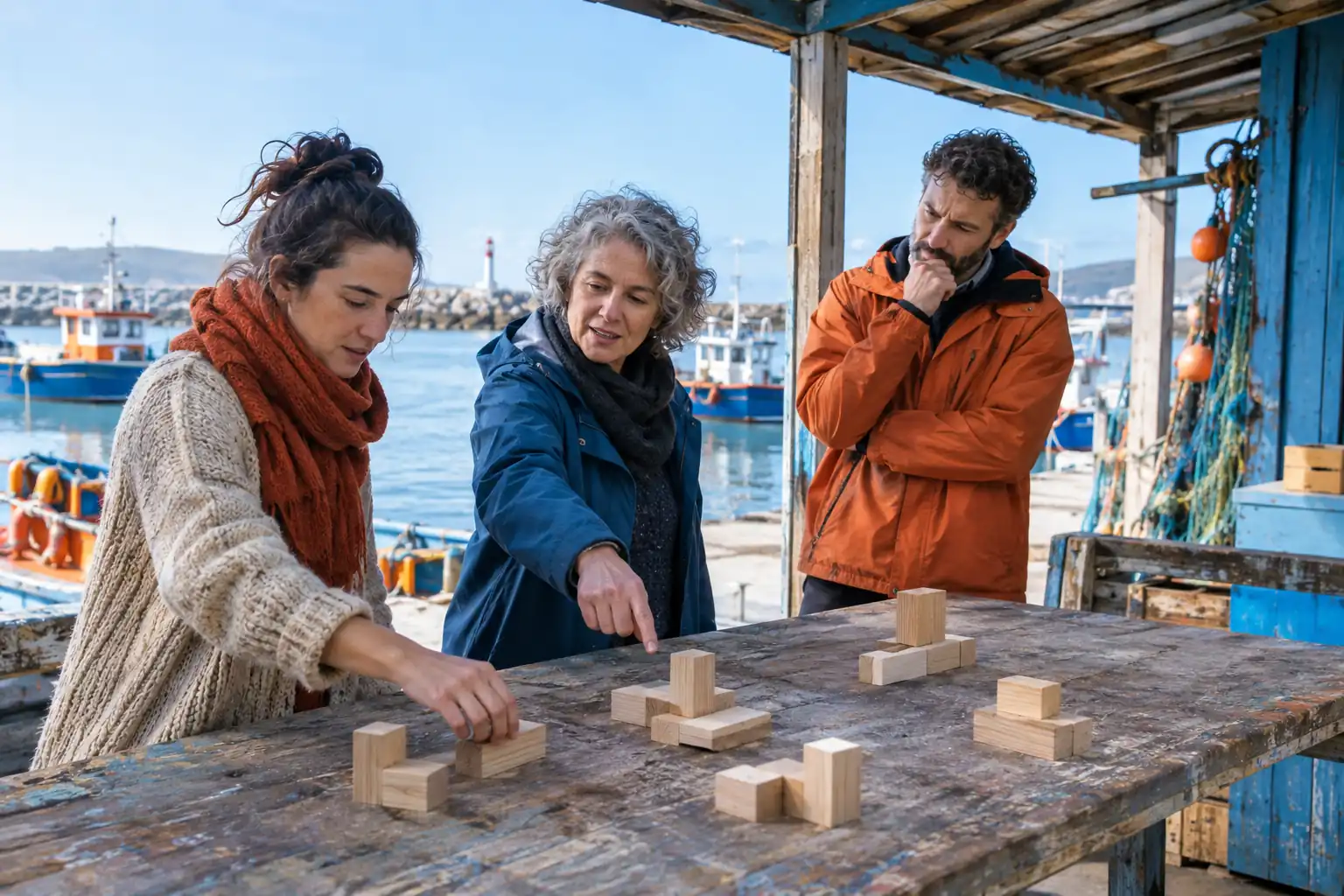
When a meeting gets stuck, take a moment to ask what the group is trying to do. Are you looking for possibilities or choosing among the ones you already have? The first task can make room for an imperfect suggestion; the second needs a fair way to weigh options.
Knowing which stage you are in can make it easier to speak up. You might want to float a rough idea while someone else is already asking about costs. Agreeing on the immediate task lets both contributions have a place, whether you meet online, in person or through written notes.
An exercise in noticing
For a low-stakes group decision, tell everyone when the group is collecting options and when it will compare them. Invite spoken or written suggestions before discussion. Then agree on one practical criterion and use it to review the options. This is an editorial exercise for adults; it was not tested as an intervention in the cited paper.
Question: At your next meeting, would it help to gather more options or to agree on how to choose?
An educational editorial exercise, not a clinical protocol.What the research investigated
Melanie S. Brucks and Jonathan Levav, affiliated with Columbia and Stanford in the United States, randomly assigned pairs to work face-to-face or by video in a laboratory experiment with 602 people and a field experiment with 1,490 engineers across five countries. Video pairs generated fewer ideas in both settings. For the quality of the idea finally chosen, the field experiment did not find a significant difference between formats. The paper first appeared on April 27, 2022; a June 7 correction restored a methods section missing from the initial HTML.
Limitations: The findings concern paired tasks with particular equipment, time limits and scoring rules. The study does not establish that video meetings harm collaboration in general or that switching formats always helps. It did not test this exercise, accessibility outcomes, long-term team performance or children.
Melanie S. Brucks; Jonathan Levav. Virtual communication curbs creative idea generation. Nature 605, 108–112. First published online: 2022-04-27. DOI: 10.1038/s41586-022-04643-y. Publisher correction: 10.1038/s41586-022-04852-5.
Source checked on 04 November 2026. Earlier research revisited today; no claim of scientific novelty or evidence for the books.
Read the primary source →Original research date: 2022-04-27.
Entirely fictional example
Entirely fictional example: Imani and Pavel are planning a neighborhood tool swap. They set aside time to collect ideas for the layout before checking what fits the available space. One suggests a repair corner; the other wants to check whether the walkway would stay clear. The pair is invented and does not illustrate a measured effect.
An invented example for reflection, not a research report, testimonial or evidence.Keywords: self-knowledge, collaboration, idea generation, decision making, videoconferencing
Download the Instagram image → · Copy or download the caption →
Editorial connection with O MÉTODO EU
The editorial connection to O MÉTODO EU is noticing when we rush from exploring to judging and making an explicit choice about how to proceed. The researchers did not evaluate or endorse the book.
A thematic connection made by the editorial team. These sources do not test the book’s effectiveness; the people mentioned are not presented as readers or endorsers of the book.Outros livros, edições e lojas
- Read the free sample and view editions
- View this Portuguese edition on Amazon Brazil
- Read the free sample and view editions
- View this Portuguese edition on Amazon Brazil
- Consulte os benefícios Prime na AmazonCapa comum — ideal para a prática do métodoVer na Amazon Brasil ↗*Consulte a elegibilidade Prime e as condições de entrega na Amazon. Publicidade · link de associado.
- United States · English — The Me Method ↗
- France · Français ↗
- 🌐 Choose from 13 Amazon stores →
Share: WhatsApp, Instagram, image and link
Instagram: download the image and choose it from your gallery in Instagram. Copy the caption below; use the link sticker in Stories.