Documented story · 4 min de leitura
SELF-KNOWLEDGE · · 3 min read
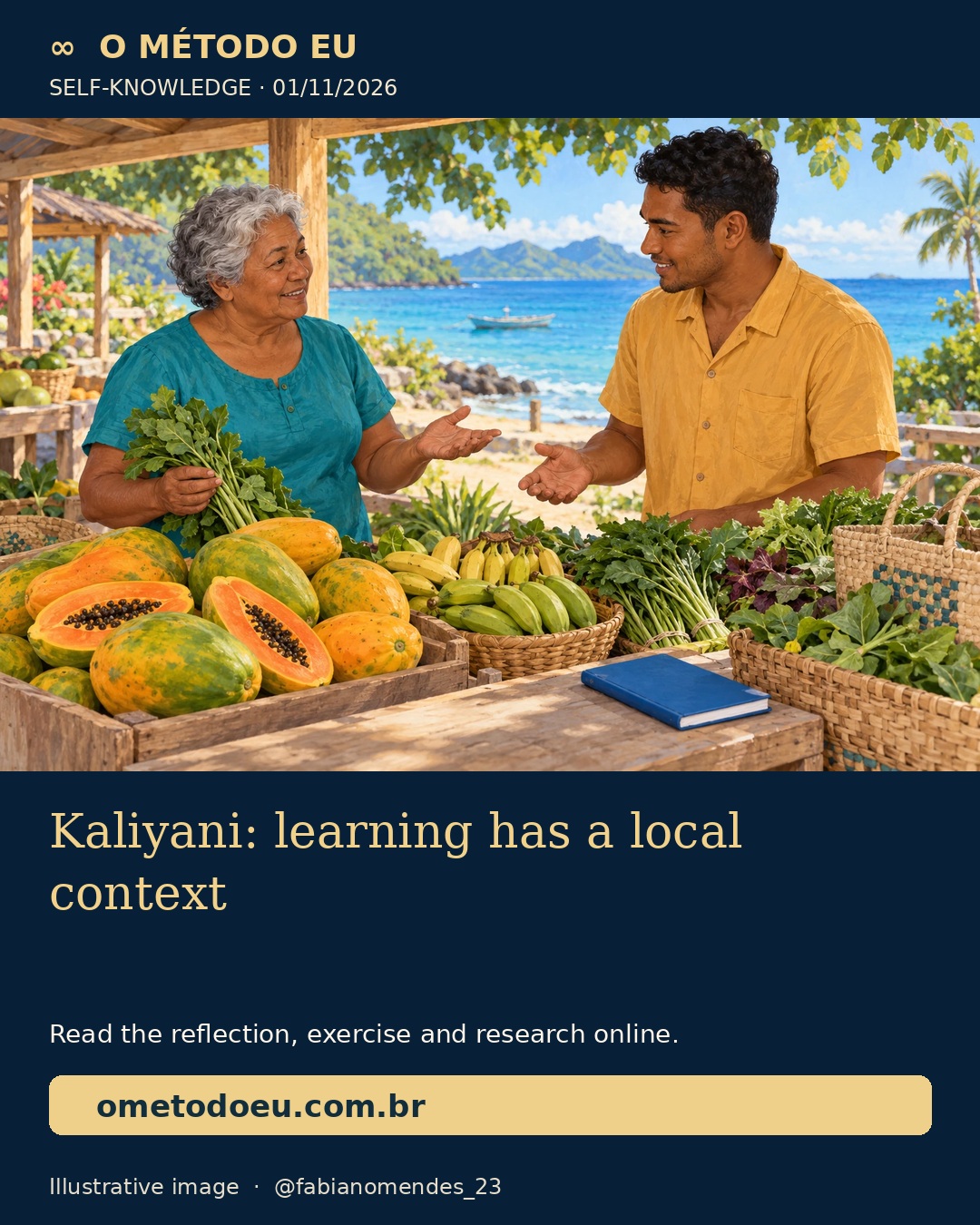
Kaliyani: learning has a local context

A general idea can become more useful when someone helps you understand where it fits. Local routines, practical questions and knowledge shared by others can reveal details that a broad success story leaves out. Recognizing what you still need to learn is a way of describing a project more honestly.
Participation also matters: having somewhere to ask a question or discuss a concern is part of the environment around a decision. You can appreciate another person's enterprise while keeping your own limits in view. Listening to experience does not require copying a business, taking a loan or assuming that the same opportunity is available everywhere.
An exercise in noticing
Choose a small project that requires no spending. Write one general idea you understand and one local detail you would need to check. Identify a reliable source or experienced person you could ask, with their agreement. This adult educational prompt is not financial or business advice and does not require investing, borrowing or changing work.
Question: Which detail would be clearer if you asked someone who knows the context?
An educational editorial exercise, not a clinical protocol.What the research investigated
Wyatt Brooks, Kevin Donovan and Terence R. Johnson, Notre Dame and Yale, USA, compared local mentoring, business classes and control among inexperienced women microentrepreneurs in Dandora, Kenya. Of 538 randomized invitees, 372 attended orientation. Mentoring increased average profits, with effects fading as matches dissolved; classes changed practices without a significant profit effect. Journal issue: October 2018; exact first-online day was not verified.
Limitations: A selected group in one Kenyan community cannot represent Fiji or every enterprise. Attendance, local relationships and the study's cash payments shape the setting. The experiment did not evaluate Kaliyani or Markets for Change, guarantee lasting profits or test the books; her account does not prove the experimental findings.
Wyatt Brooks; Kevin Donovan; Terence R. Johnson. Mentors or Teachers? Microenterprise Training in Kenya. American Economic Journal: Applied Economics 10(4), 196–221, October 2018. DOI: 10.1257/app.20170042. Date precision: month.
Source checked on 01 November 2026. Earlier research revisited today; no claim of scientific novelty or evidence for the books.
Read the primary source →Original research date: October 2018 (journal issue; exact first-online day not verified).
Documented real-life story
A UNDP Pacific story published on 24 September 2026 described Kaliyani Swamy's work at Lautoka Municipal Market in Fiji. She reported learning through Markets for Change and the market-vendor association, including records, separating household and business money, and communicating with customers. The account also identifies her association role and learning with other vendors. This summary attributes those practices to the dated account; it does not verify later profits or claim that training alone caused business success.
Kaliyani Swamy — UNDP institutional account, Lautoka, Fiji · UNDP Pacific, Growing with Confidence: Kaliyani's Journey as a Woman Entrepreneur, 24 September 2026, including Kaliyani Swamy's public statements; independent editorial summary, not an interview by this portal. · 2026-09-24
Read the original account →A published individual account; it does not establish causality, a universal cure or guaranteed results. It does not imply use or endorsement of O MÉTODO EU.Keywords: self-knowledge, practical learning, local knowledge, participation, projects
Download the Instagram image → · Copy or download the caption →
Editorial connection with O MÉTODO EU
The editorial connection with O MÉTODO EU is noticing a knowledge gap, examining assumptions and considering the conditions around a choice. Neither Kaliyani's account nor the Kenyan experiment demonstrates the book's effectiveness or suggests she read or endorsed it.
A thematic connection made by the editorial team. These sources do not test the book’s effectiveness; the people mentioned are not presented as readers or endorsers of the book.Outros livros, edições e lojas
- Read the free sample and view editions
- View this Portuguese edition on Amazon Brazil
- Read the free sample and view editions
- View this Portuguese edition on Amazon Brazil
- Consulte os benefícios Prime na AmazonCapa comum — ideal para a prática do métodoVer na Amazon Brasil ↗*Consulte a elegibilidade Prime e as condições de entrega na Amazon. Publicidade · link de associado.
- United States · English — The Me Method ↗
- France · Français ↗
- 🌐 Choose from 13 Amazon stores →
Share: WhatsApp, Instagram, image and link
Instagram: download the image and choose it from your gallery in Instagram. Copy the caption below; use the link sticker in Stories.