Documented story · 4 min de leitura
SELF-KNOWLEDGE · · 3 min read
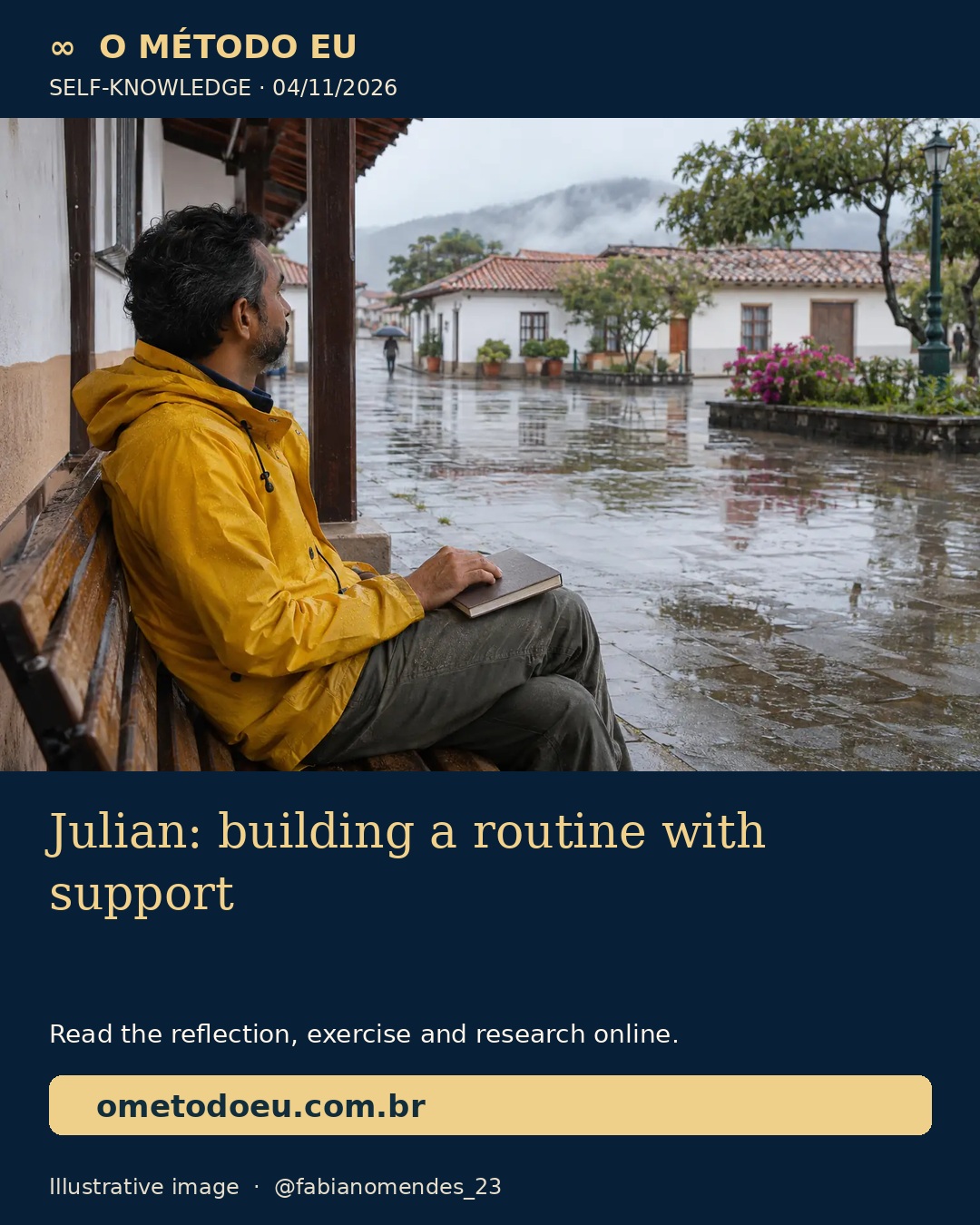
Julian: building a routine with support

Getting up at a regular time may look unremarkable from the outside. In a life that has become difficult to organise, the return of an ordinary activity can matter in its own right. Its value does not depend on how impressive it sounds or whether it can be turned into a lesson for someone else.
A routine is easier to describe when we name what makes it possible. There may be an appointment, someone to check in with, or enough time to try again after an interruption. A change that looks individual often has a history of support that deserves to be told.
An exercise in noticing
Choose a low-stakes routine unrelated to substance use, such as putting a book where you will see it. Note one condition that would make the activity easier and one person you could ask for a practical favour, if appropriate. Treat this as an adult reflection on everyday arrangements, not a plan for reducing or stopping alcohol use.
Question: What support would make one ordinary part of your week easier to return to?
An educational editorial exercise, not a clinical protocol.What the research investigated
The UKATT Research Team randomly assigned 742 clients aged over 16 across seven UK sites to social behaviour and network therapy or motivational enhancement therapy. Both groups reported fewer alcohol-related problems and lower consumption over 12 months; the trial found no significant difference between the therapies on its main drinking outcomes at 12 months. It was first published online on 8 September 2005.
Limitations: There was no untreated comparison group; improvement in both groups does not isolate the effect of either therapy against no care. The sample was mostly men and White, and 617 participants completed the 12-month interview. This was a comparison of formal therapies, not an evaluation of Julian, his programme, routine-setting by itself or this book. It provides no individual treatment recommendation or basis for extrapolating to children.
UKATT Research Team. Effectiveness of treatment for alcohol problems: findings of the randomised UK alcohol treatment trial (UKATT). BMJ 331, 541. First online 2005-09-08; issue 2005-09-10. DOI: 10.1136/bmj.331.7516.541. See also the 2019 correction to Figure 1, DOI: 10.1136/bmj.l6608.
Source checked on 04 November 2026. Earlier research revisited today; no claim of scientific novelty or evidence for the books.
Read the primary source →Original research date: 2005-09-08.
Documented real-life story
In a WithYou account published on 2 October 2026, Julian spoke about using alcohol to cope and finding that trying to manage alone did not work for him. The organisation describes hospital and residential care, support from its East Ayrshire service and his later participation in a recovery group. Julian said that a supported online programme helped him look at his past choices and behaviour. The account also describes a return to activities at home. This is a dated account, not an update on his health or sobriety.
Julian — public account from East Ayrshire, Scotland; first name as published · WithYou, Julian’s story, 2 October 2026. Editorial summary of Julian’s public remarks and the organisation’s account of his care; no interview by this site. · 2026-10-02
Read the original account →A published individual account; it does not establish causality, a universal cure or guaranteed results. It does not imply use or endorsement of O MÉTODO EU.Keywords: recovery support, everyday routine, self-knowledge, professional care
Download the Instagram image → · Copy or download the caption →
Editorial connection with O MÉTODO EU
O MÉTODO EU provides an editorial connection to noticing a repeated pattern and asking what support makes a different choice possible. The book is not part of Julian’s account or the UKATT intervention.
A thematic connection made by the editorial team. These sources do not test the book’s effectiveness; the people mentioned are not presented as readers or endorsers of the book.Outros livros, edições e lojas
- Read the free sample and view editions
- View this Portuguese edition on Amazon Brazil
- Read the free sample and view editions
- View this Portuguese edition on Amazon Brazil
- Consulte os benefícios Prime na AmazonCapa comum — ideal para a prática do métodoVer na Amazon Brasil ↗*Consulte a elegibilidade Prime e as condições de entrega na Amazon. Publicidade · link de associado.
- United States · English — The Me Method ↗
- France · Français ↗
- 🌐 Choose from 13 Amazon stores →
Share: WhatsApp, Instagram, image and link
Instagram: download the image and choose it from your gallery in Instagram. Copy the caption below; use the link sticker in Stories.