Documented story · 4 min de leitura
SELF-KNOWLEDGE · · 3 min read
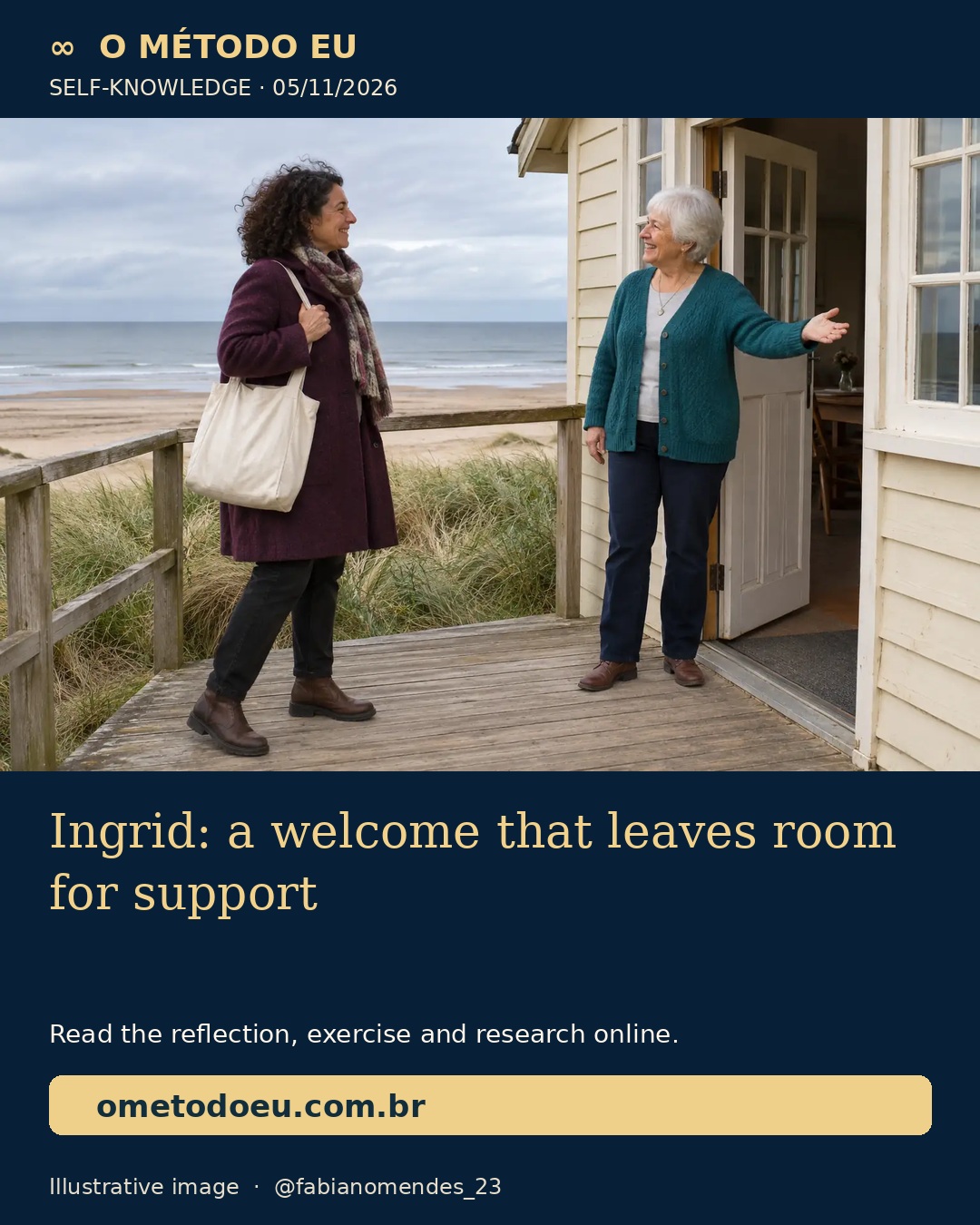
Ingrid: a welcome that leaves room for support

The first greeting can be one small part of a much longer encounter. A person may remember a face, a tone of voice or the feeling that they were allowed to arrive without having everything explained. Taking that memory seriously does not make kindness a substitute for specialist care. It gives us a reason to consider how we make room for a conversation.
When we tell a recovery story, it matters to keep the support in the picture. Appointments, trained professionals, colleagues and relationships can all have a place in a person’s account. Their experience can invite attention without becoming a promise about anyone else’s pace or outcome.
An exercise in noticing
For an ordinary, low-stakes conversation, write one opening sentence that offers someone a choice: whether to talk, where to sit or when to return to the subject. Respect a refusal without pressing for disclosure. This adult editorial exercise is not a grief treatment, assessment or plan to reduce or stop alcohol use.
Question: What would make an everyday conversation easier to enter without having to explain everything at once?
An educational editorial exercise, not a clinical protocol.What the research investigated
Katherine Shear, Ellen Frank, Patricia R. Houck and Charles F. Reynolds III, University of Pittsburgh, United States, compared complicated grief treatment with interpersonal psychotherapy in a randomized trial involving 95 adults. Both treatments involved approximately 16 sessions. Response was reported in 51% versus 28% respectively. The study was published on June 1, 2005.
Limitations: This small clinical trial had substantial dropout and excluded current substance abuse or dependence. It did not test alcohol recovery, Ingrid’s care, a warm greeting, children or the book. Her account does not establish that she had the trial’s diagnosis or received its treatment. The exercise is not the intervention.
Katherine Shear; Ellen Frank; Patricia R. Houck; Charles F. Reynolds III. Treatment of Complicated Grief: A Randomized Controlled Trial. JAMA 293, 2601–2608. First published: 2005-06-01. DOI: 10.1001/jama.293.21.2601.
Source checked on 05 November 2026. Earlier research revisited today; no claim of scientific novelty or evidence for the books.
Read the primary source →Original research date: 2005-06-01.
Documented real-life story
In a WithYou account dated October 7, 2026, Ingrid recalled seeking alcohol support at Shropshire Recovery Partnership ten years earlier. She remembered nurse Jane’s welcoming manner and described specialist mental health support, including grief work, as important in her recovery. She later volunteered and worked in services, becoming a team leader according to that publication. This is her attributed experience at a stated date, not an independent assessment of treatment, a claim about her current health or a universal recovery sequence.
Ingrid — first name as published by WithYou, Shropshire, England · WithYou, “I cannot believe my luck”: Ingrid on coming full circle at Shropshire Recovery Partnership, 7 October 2026. Summary of Ingrid’s published first-person statements; no interview by this portal. · 2026-10-07
Read the original account →A published individual account; it does not establish causality, a universal cure or guaranteed results. It does not imply use or endorsement of O MÉTODO EU.Keywords: self-knowledge, welcoming support, alcohol recovery, grief, adult reflection
Download the Instagram image → · Copy or download the caption →
Editorial connection with O MÉTODO EU
The editorial connection to O MÉTODO EU is noticing what helps a conversation feel possible and naming support rather than treating recovery as willpower alone. This is a thematic reflection: Ingrid is not presented as a reader or endorser, and the trial did not evaluate the book.
A thematic connection made by the editorial team. These sources do not test the book’s effectiveness; the people mentioned are not presented as readers or endorsers of the book.Outros livros, edições e lojas
- Read the free sample and view editions
- View this Portuguese edition on Amazon Brazil
- Read the free sample and view editions
- View this Portuguese edition on Amazon Brazil
- Consulte os benefícios Prime na AmazonCapa comum — ideal para a prática do métodoVer na Amazon Brasil ↗*Consulte a elegibilidade Prime e as condições de entrega na Amazon. Publicidade · link de associado.
- United States · English — The Me Method ↗
- France · Français ↗
- 🌐 Choose from 13 Amazon stores →
Share: WhatsApp, Instagram, image and link
Instagram: download the image and choose it from your gallery in Instagram. Copy the caption below; use the link sticker in Stories.